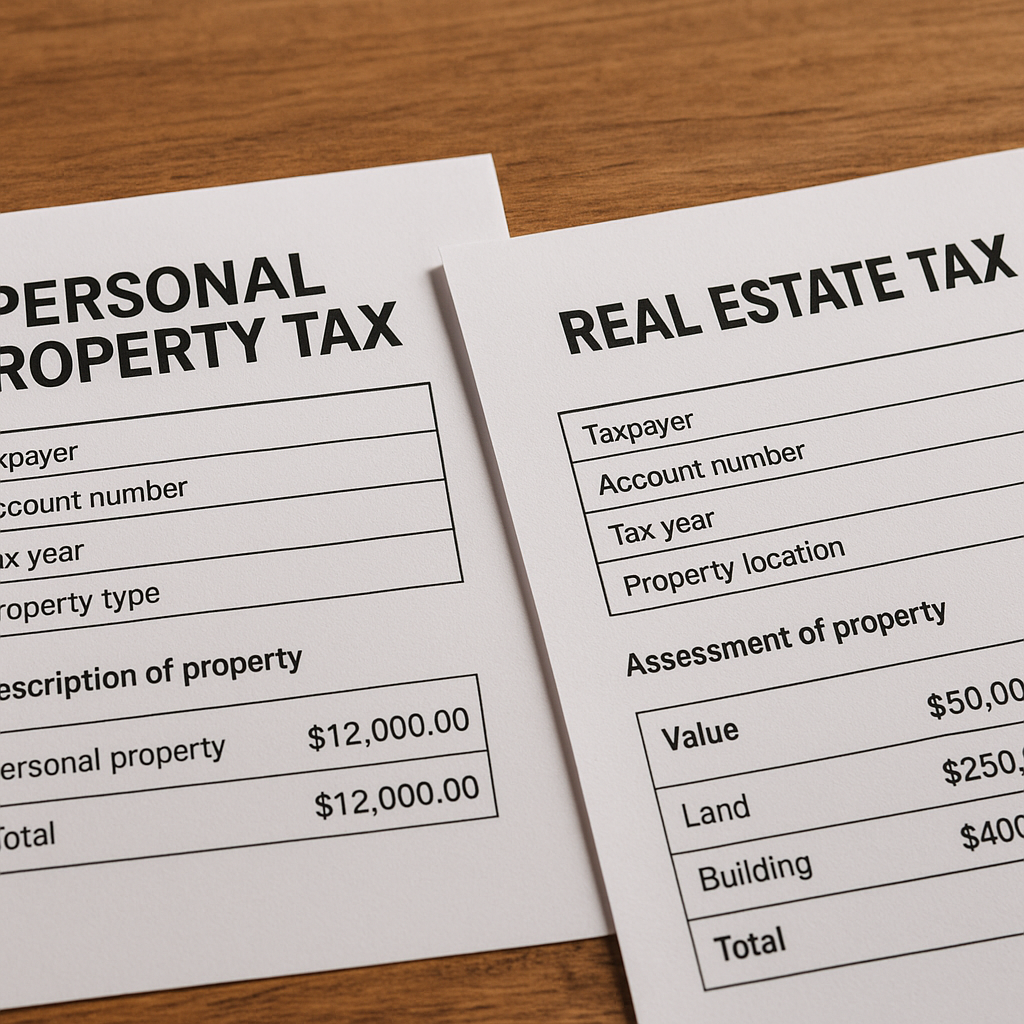
Difference between personal property tax and real estate tax
I run a small advisory desk out of Austin, and after fifteen years of helping guys sort through county bills and business filings, I still watch people trip over the exact same phrasing every spring. You close on a house, open the assessor’s portal, and suddenly wonder why your statement looks nothing like your neighbor’s. The confusion stems from how local jurisdictions classify what you actually own. I break down the mechanics below so you stop guessing where your money goes and how the rates get calculated.
Property vs real estate tax
The phrasing sounds interchangable until you start reading municipal codes. In plain terms, the broader category covers anything a local government can levy a value-based charge on. Ad valorem systems measure worth at a specific snapshot date, then apply a local millage rate. Most counties separate movable items from fixed assets, which changes your rate, your appeal window, and your payment schedule. If you run a contracting business or lease heavy equipment, you will see a completely different billing cycle than your residential neighbors.
Personal property vs real property
When we talk about tangible holdings, the split comes down to mobility and attachment to land. Real property means the soil, structures permanently bolted to it, and fixtures that legally transfer with the deed. Personal property covers vehicles, machinery, inventory, and even certain leased assets depending on your state. Historically, this classification dates back to agrarian economies where land was the only measurable wealth. The Industrial Revolution forced assessors to track railroads and factory lines, and the digital shift added leased solar arrays, server racks, and fleet EVs to the taxable roll. That evolution explains why your county now asks for a separate declaration on office computers while your house gets a separate appraisal.
“The line between movable and fixed assets isn’t just legal jargon; it dictates which government office sends you the bill, how often they reassess, and what exemptions actually apply.” — State Tax Policy Review, 2025
Real estate tax vs property tax
Locally, officials often swap both phrases on the same form, but the accounting departments treat them differently. One targets immovable holdings exclusively, while the other functions as an umbrella term. If your municipality collects both, you might see two separate statements: one for your lot and dwelling, another for business equipment or recreational vehicles. The overlap creates genuine friction during audits because some jurisdictions fold the land levy into the general column, while others keep the ledgers strictly divided. You will notice this most clearly when buying out a commercial lease or transferring ownership of a family trust.
| Classification | Typical Examples | Assessment Frequency |
| Land & Structures | Houses, commercial buildings, permanent foundations | Annual or biennial |
| Mobile & Business Assets | Company vehicles, leased machinery, inventory | Yearly declaration required |
Is real estate tax the same as property tax
Technically, no, even though the phrasing gets swapped in casual conversation. The narrower term applies strictly to immovable assets, while the wider phrase encompasses everything from a tractor to a factory line. Over the last twenty years, remote work and decentralized supply chains forced assessors to adapt. Counties now track home office gear, mobile workstations, and cloud infrastructure leases that simply did not exist in traditional ledgers. That shift means your total obligation can change even if your square footage stays identical. You can track updated millage rates and exemption thresholds through official municipal portals like the federal guidance page, which cross-references state-level methodologies, or check regional compendiums such as the Census Bureau’s annual housing finance reports. Keep your purchase receipts and depreaciation scheduals organized for audit season, and always verify that assessor data matches actual renovations.
- File movable asset declarations before the county deadline to avoid penalties.
- Request exemption forms for primary residences, agricultural use, or veteran status.
- Track depreciation values for equipment to lower future declarations.
- Verify square footage and recent upgrades match public records.
Understanding how local offices categorize your holdings saves time when you navigate reassessments, appeal windows, and payment schedules. The system rewards documentation and penalizes assumptions, so I always recommend keeping a clean paper trail for anything you depreciate or transfer across fiscal years.